
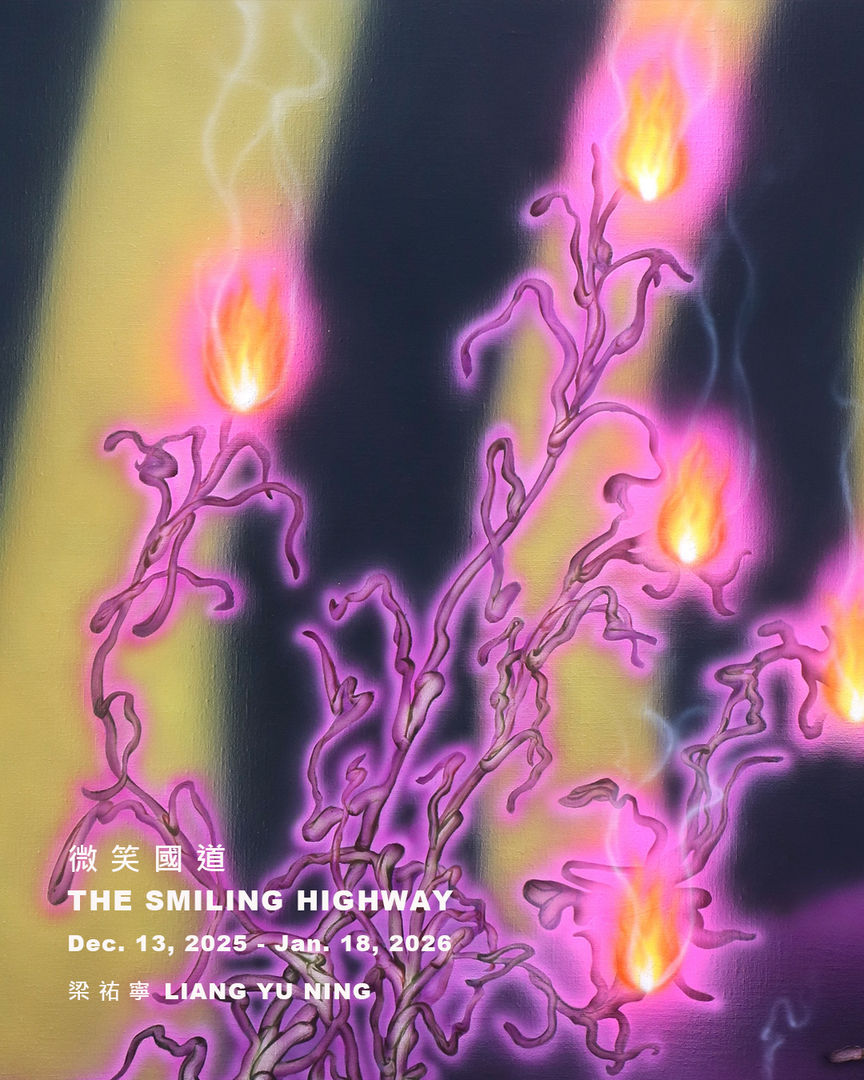
“The Smiling Highway” centers on the psychological states that emerge during long-distance driving and the monotony of continuous movement.
“The Smiling Highway” centers on the psychological states that emerge during long-distance driving and the monotony of continuous movement. After becoming a son-in-law of Kaohsiung, the shift in identity brought frequent travels between the north and south. The four- to five-hour journey became a space for inner dialogue and mental formation. Throughout the drive, consciousness fragments into illogical yet undeniably real impressions: bird droppings on the windshield, mannequin traffic controllers, the glare of oncoming high beams, the pressure from flashing headlights behind, hurried roadside snacks, a cigarette butt tossed at a red light, the heaviness of eyelids, the fatigue of vision. These fleeting sensations, trivial yet charged, form the delicate structure of the driver’s psychological landscape, stretching along the route and weaving into a journey with no clear end.
Inside the car lies a private space in motion. The external scenery speeds past—precise, regulated, rhythmic—while the cabin remains still, functioning as a temporary psychological container detached from everyday routines, suspended between external noise and inner quiet. The highway is built upon strict systems of symbols and regulations: distance, speed limits, lane markings, shoulders—all requiring precise uniformity. Yet within this tightly disciplined environment, the mind grows tired, drifting easily. Spacing out becomes an instinctive resistance to monotony, prompting us to reconsider the meaning of everyday movement.
This body of work adopts painting as its narrative core, incorporating airbrushing, acrylic brushwork, and modified found objects to reconstruct driving perspectives, rear-view mirrors, and highway symbols. Mirror-like readymades are transformed into canvases, turning the rear-view mirror from a reflector of reality into a vessel for wandering imagination. Highway signs are reshaped into “plum-blossom smiley faces,” converting functional markers into personal emotional symbols. These images oscillate between real road scenes and internal psychological landscapes, intersecting and overlapping in motion.
Within the exhibition, viewers become passengers, witnessing a journey triggered by physical travel and woven by drifting consciousness. Through this inner roaming on the expressway, “The Smiling Highway” invites us to reflect: in the ordinary continuity of daily travel, how does our mind quietly form, disperse, and reshape our understanding of the world?
