
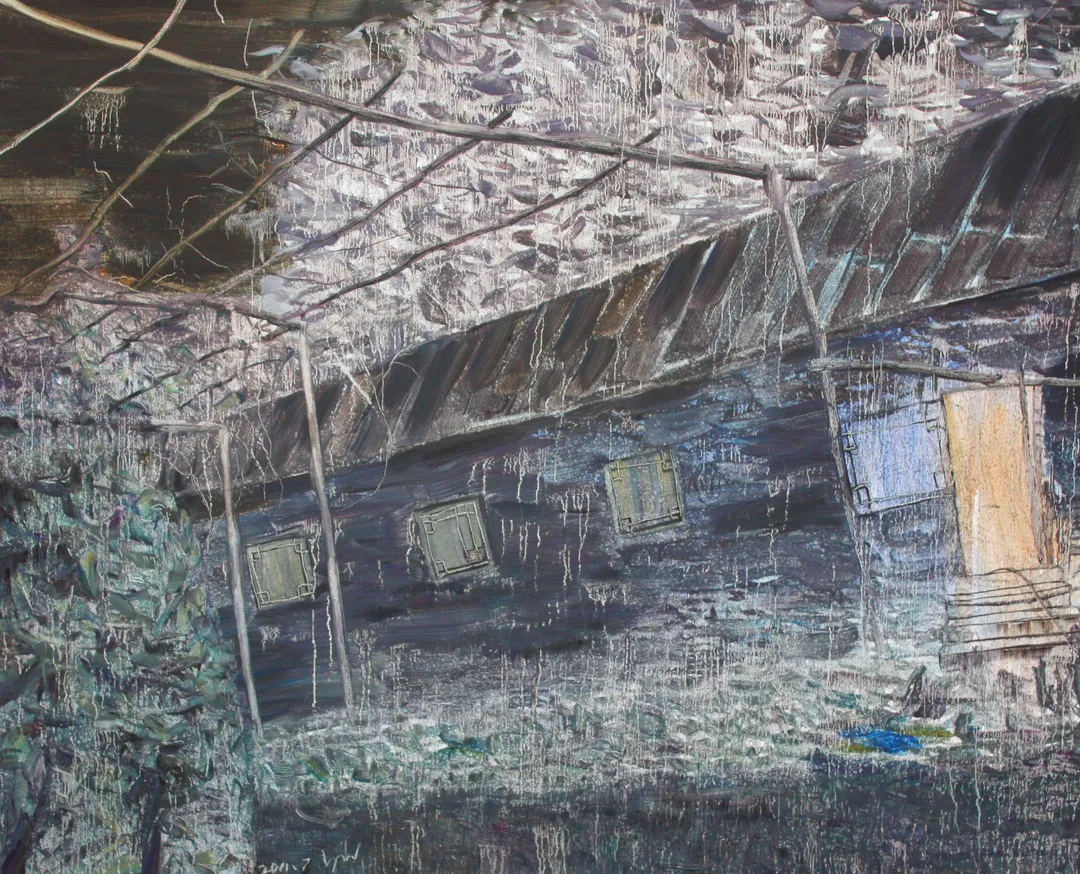
Submergence
Submergence is a displacement of the spirit. It is not a physical descent, but a withdrawal from the fringes of reality—a conscious freefall into the depths of one’s inner consciousness.
As we distance ourselves from the clamor of the surface, light begins to linger, sound is folded by heavy pressure, and time loses its fixed direction. This exhibition explores two contrasting yet coexisting states—“Sedimentation” and “Fluidity”—to initiate a sensory journey on the border between reality and illusion.
[Sedimentation: The Relics of Time]
One visual language leans toward calmness. Colors are stripped back to their minimalist essence, leaving only faint traces of light and shadow. The space feels as though it has been repeatedly washed by time, leaving behind only residual structures and the signs of slow breathing. This is not a desolate ruin, but a state of focused contemplation. As the external noise fades, matter exists in its quietest form, condensing into a steady weight that solidifies memory into the quietest coordinate of the heart.
[Fluidity: The Interface of Perception]
The other visual language is one of constant expansion. Through textures that mimic biological membranes or organic tissues, the imagery transforms local parts of the body into macro-imaginings of space. Here, the restrained palette allows us to focus on the essence of things. Soaring and falling occur simultaneously; creation and collapse become prerequisites for one another. Space is no longer a fixed container but a fluid illusion, capturing those unutterable tremors that drift between reality and dream.
Between these two rhythms, a deep field of perception takes shape. On one side is the settling of weight; on the other, the buoyancy of light.
Sedimentation is not stasis; fluidity is not an escape.
Stillness is not true stagnation, and flow does not necessarily lead to a distant place. Together, they constitute a delicate state—suspended between disappearance and birth, between clarity and indulgence.
The movement of the viewer through the space is like adjusting the frequency of one’s own breath. Descending is not about fleeing life, but about recognizing the invisible pressures surrounding us. Submergence is not the end, but an extension of perception. As the eyes gradually adapt to the darkness, new directions emerge from the depths.
Submergence, therefore, becomes a slow yet conscious way of existing—a way to hear the pulse of one’s own inner heart amidst a turbulent world.

